Every lesson checked before it is booked.
WingsPath schedules your flying against live airworthiness, crew duty limits and licence expiry — and when it refuses a booking it tells you exactly which check failed and why. Training records carry everything the regulator asks for, signed by the instructor and acknowledged by the student.
- AIRWORTHINESS2 OVERDUE
- DUTY LIMITSWITHIN
- MEDICALEXPIRES 12 SEP
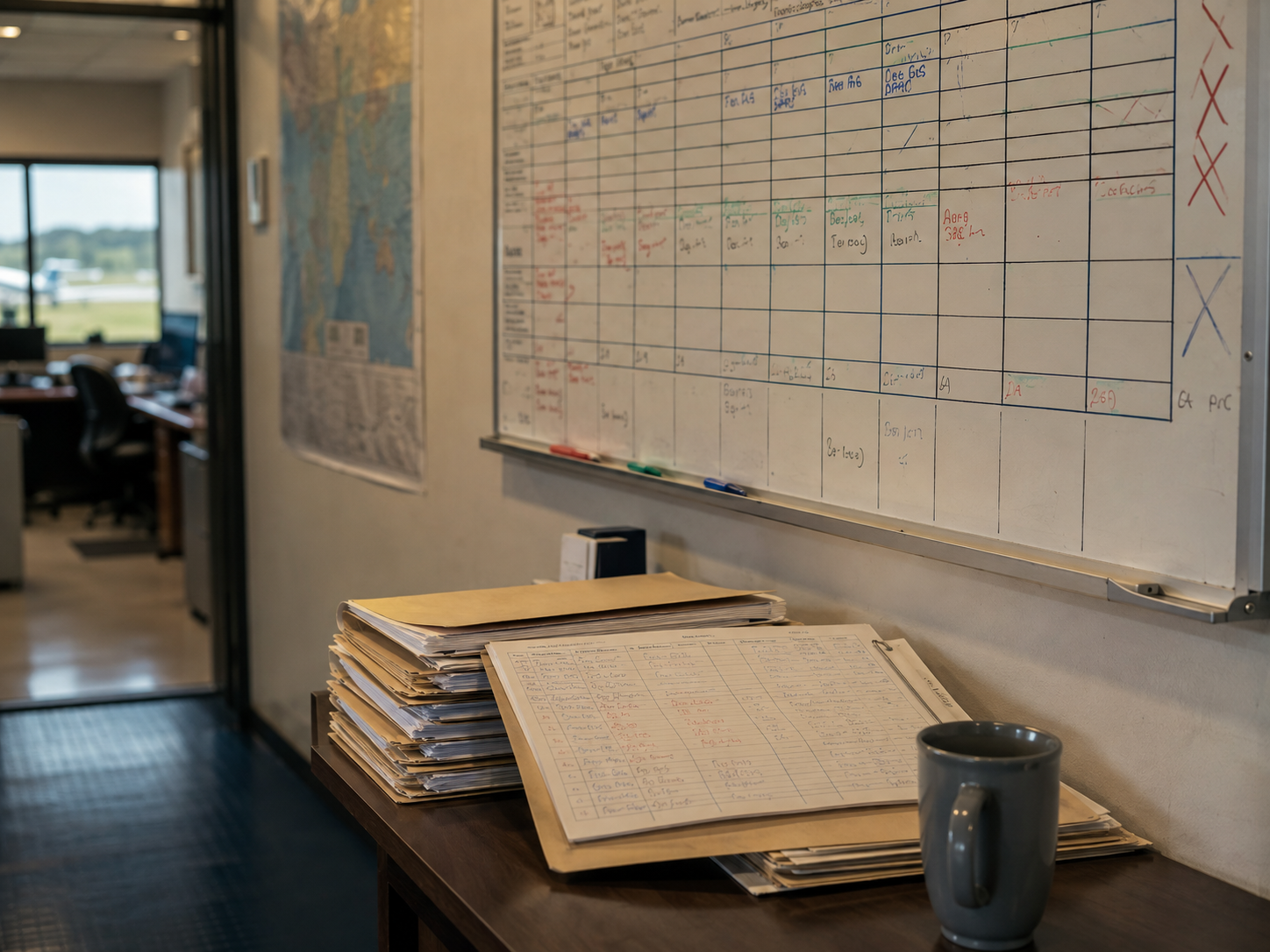
A school's paperwork is its approval.
KCAA numbers every practical exercise from 1 to 20 — first familiarisation through to night flying — and wants that number written in the student's logbook. A spreadsheet cannot tell you who still owes exercise 17.
The regulator asks each lesson to record the exercise flown, the standard reached, three running hour totals, anything skipped or left incomplete, and the instructor's comment on the student's attitude as well as their flying — plus the student's own signature confirming the debrief happened. Most schools carry about half of that.
The flight is flown, the logbook is signed, and the billing is reconstructed later from memory and a rate somebody remembers agreeing.
Built around how a flight school actually runs.
A board that refuses, and explains itself.
Book a lesson and three gates run: the aircraft's airworthiness, the instructor's and student's duty limits, and every licence and medical against the lesson date — not today's date. A refusal names the overdue item, the rule and the expiry. An organisation admin can override, and the reason is recorded on the booking permanently. The database itself refuses to double-book an aircraft, an instructor or a student.
The record KCAA asks for, signed twice.
The exercise number KCAA uses, the standard reached, hours before / today / carried forward, anything skipped, and the instructor's assessment of performance, progress and attitude. The instructor signs — and the record then waits for the student to acknowledge their own debrief. Nobody can do that for them. Authorisations to fly still have to sit on serially numbered pages, as though it were the carbon book the rule was written for: each one gets the next number in an unbroken sequence plus a digital fingerprint of its contents, so a removed page shows up. A paper book could never do that.
Enrolment to first solo, on one thread.
Students sit on the same spine as your crew, so a person is one record whether they are learning or instructing. Guardian consent for minors is enforced by the database, not by a reminder. A course snapshots its syllabus at enrolment, so changing next year's course never rewrites last year's student. Progress is derived from signed records — and a student who moves school leaves with a certified transfer bundle.
Charged from the signed leg, not from memory.
Rate cards are versioned, so a mid-course student keeps the rate they contracted. Flight charges derive from signed block time — an unsigned leg cannot be billed. School revenue, KCAA pass-through and money paid direct to an examiner stay in three separate buckets and are never merged. The ledger is append-only: a mistake is reversed, never edited away.
Meet Neema.
Neema is here to help — the assistant built into every WingsPath screen. Ask a question in your own words about your records; Neema answers from what's actually on file, cites the source document, and says plainly when the evidence isn't there instead of guessing a number, a date or a serial.
The same assistant also answers questions about using WingsPath itself, so nobody on your team is stuck reading a manual mid-shift.
"Which students still owe Exercise 17?"
Kenya's regulations say a school must train to a syllabus. A separate KCAA document says what that syllabus actually contains — and it is the one most schools' own course material predates. We build to the second one.
An instructor cannot acknowledge a debrief on a student's behalf — the endpoint is the student's and nobody else's. That is what makes the signature evidence.
A training record is replaced by a new version, never overwritten, and every version is kept. That is what KCAA asks of a school's records, and it is what an auditor checks.
KCAA requires a school to back its training records up daily to a second site. Ours runs at 02:30, is encrypted on the way out, and is restore-tested.
Put your school on one record.
We onboard schools individually while we grow the platform. Tell us your fleet, your intakes and your approved scope, and we will bring your students in with you.